

CIVIC AGRICULTURE
The term “civic agriculture“ is used as an umbrella category and in the European context is not an unified statistical or legal category like, for example, “organic agriculture” or “social agriculture”. As an idea it stands for reconnecting agriculture, food, and communities. It refers to the food production, distribution and services provided by and for local communities. It brings together several issues strongly promoted by EU policies, including community participation, local food systems, sustainability, and circular economy practices. The meaning of “civic” relates primarily to the citizen as a member of a community, rather than to the idea of belonging or being connected to the city as a physical place.
The term is also connected to short supply chains, while emphasizing the crucial role of civil society engagement, rural communities, and generational renewal in agriculture. At the same time, it is a set of localized and often hybrid practices that create direct relationships among producers, consumers, local enterprises, and both urban and rural spaces.
Erasmus+ CIVICA project
CIVICA is an Erasmus Plus KA2 small-scale partnership project in the field of adult education, co-funded by the European Union. The project aims to promote and contribute to the development of innovative models of civic and sustainable agriculture by engaging young adults, unemployed people, and NEETs, while encouraging the development of new farming initiatives in both urban and rural areas.
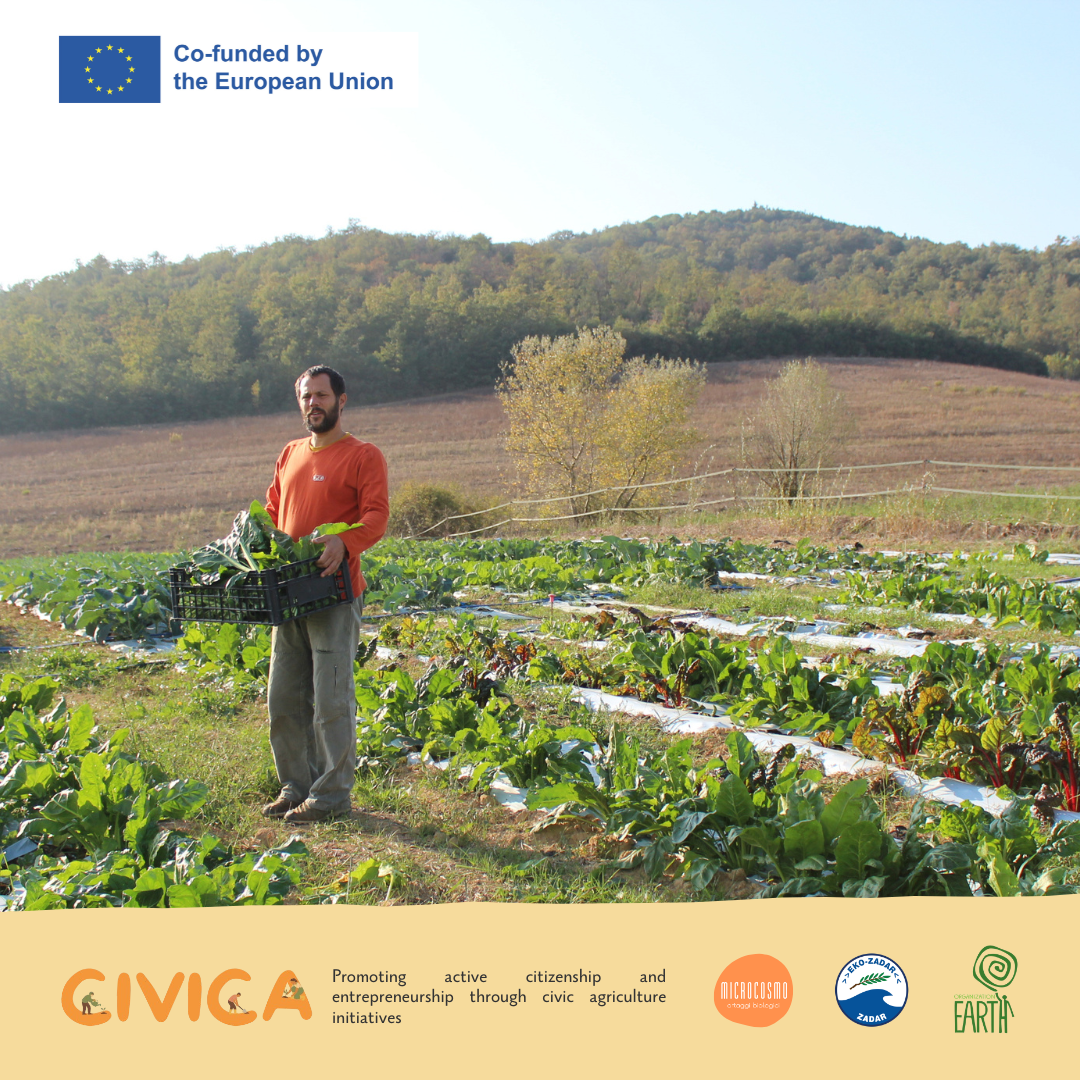
CIVICA Partnership
Three partners from three European Union countries (Italy, Greece and Croatia) collaborate in the CIVICA project, combining expertise in organic, social, civic and sustainable agriculture, environmental education and active citizenship.

Coordinator (Italy)

Partner (Greece)

Partner (Croatia)